Cattle Feeds for Milk: How Much Wanda to Give a Cow or Buffalo
Cattle feeds for milking animals follow one common working rule: about 1 kg of concentrate for every 2 to 2.5 litres of milk, on top of good green fodder. Cows sit near 2.5 litres per kg and buffalo nearer 2. Raise the amount slowly over one to two weeks and split it into two or three meals.
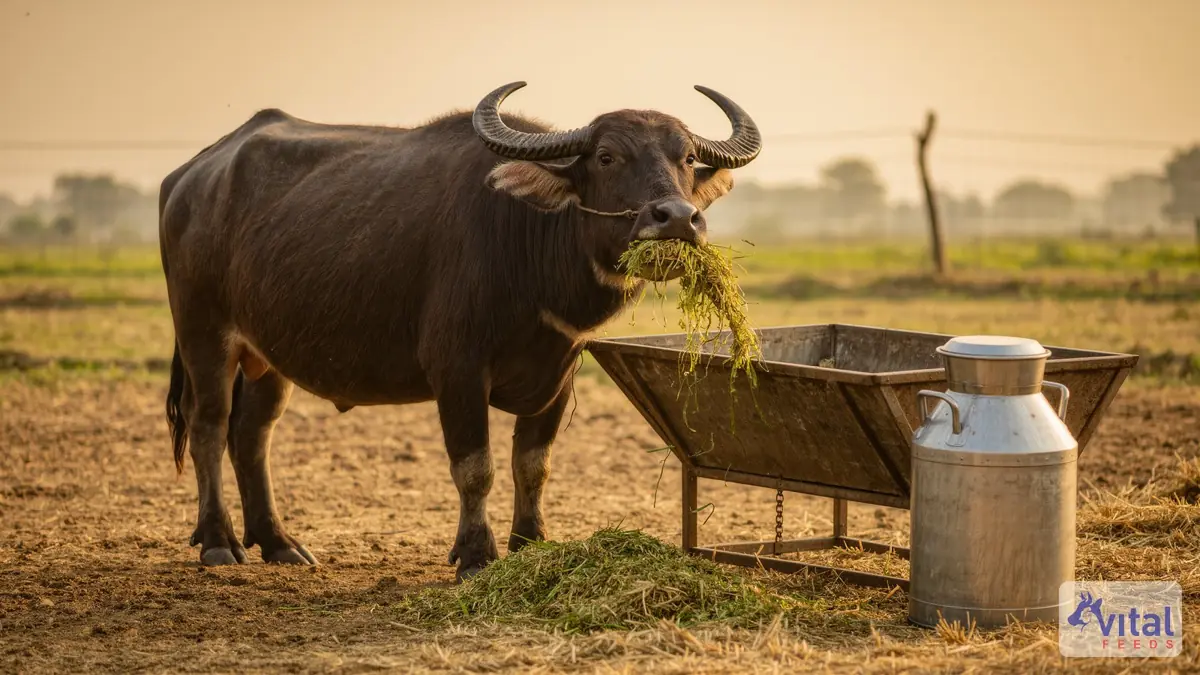
Weigh the concentrate by each animal's milk yield, and keep green fodder as the base.
How much cattle feeds should a milking cow or buffalo get?
Think of concentrate as a top-up, not the main meal. South Dakota State University's extension service puts it plainly: the first requirement is to give the milking herd all the top quality forage it will eat. The animal's base is green fodder and dry roughage. Concentrate, often called wanda in Punjab, fills the energy and protein gap that fodder cannot cover once the milk yield goes up.
Use the yield of that animal, not the herd average, to set the amount.
| Daily milk | Cow (about 2.5 L per kg) | Buffalo (about 2 L per kg) |
|---|---|---|
| 8 litres | 3.2 kg | 4 kg |
| 12 litres | 4.8 kg | 6 kg |
| 16 litres | 6.4 kg | 8 kg |
These are working figures to start from. Weigh the feed for a week instead of guessing with a scoop, because a scoop can hold very different weights from one worker to the next. Then watch the milk record and the animal's body condition and adjust.
Does more wanda always mean more milk?
No, and this is where many farms lose money. The Farm Advisory Service in Scotland notes that the response to extra concentrate is not linear. At low feeding levels, 0.3 to 0.4 kg may buy one extra litre, but at high levels it can take up to 1.6 kg for one more litre.
Those figures come from dairy cows in Scottish herds, not buffalo in Punjab, so use them as a warning about the shape of the curve, not as a Pakistani target. The lesson is simple: past a point, the extra bag costs more than the extra milk is worth, and the animal starts to eat less fodder.
How should I bring a new animal onto wanda and cattle feed?
- Start with about a third of the target amount.
- Add a little every second day until you reach the target in one to two weeks.
- Split the ration into two or three meals, not one large bucket.
- Keep clean water in front of the animal all day. A milking buffalo drinks a lot, and low water intake lowers milk faster than low feed.
- Never feed concentrate alone. Long fibre keeps the rumen working.
- Check the milk record after two to three weeks, not after two days.
Dry animals need only a small amount. Do not carry the milking ration into the dry period.
What goes wrong most often?
- A big change in one day, which can upset the rumen and cut the appetite.
- Too little fodder, so the concentrate has to do all the work.
- Damp feed stored in a hot shed. Mould appears quickly in humid months, so keep bags off the floor and away from the wall.
- Feeding by habit when the yield has changed. A buffalo giving 10 litres in week 3 and 7 litres in week 20 needs a different ration.
Pakistan notes: seasons and fodder
In summer, heat stress lowers appetite, so give wanda in the cooler hours and keep shade and water close. In winter, berseem is rich and wet, which can make animals feel full while the dry matter intake stays low. Check the milk record when the fodder changes, and adjust the concentrate to match.
If you are raising calves for the next milking herd, read our calf starter guide on the same blog.
What does Vital Feeds offer for dairy animals?
Vital Feeds makes Dairy Vanda, a balanced concentrate for milking buffalo and cows, milled in Arifwala, Punjab. The mill can share nutrient specifications on request. You can see how it is fed on the Vital Feeds dairy page.
Quick questions
Can I feed wanda to a heifer? Young stock has its own needs. Ask the mill or your vet for the right feed for the age.
How do I know the ration is right? Stable milk records, a normal appetite for fodder and steady body condition are the three signs.
Is the one-kilo-per-two-litres rule exact? No. It is a starting point. Always adjust to the animal.
Written by Waqas Rafiq, CEO of Vital Feeds and founder of EL TESSA


Comments
Post a Comment